




Community Development Recommendation 5
Workforce Development
Issue
The Columbia River treaty tribes play a major role in salmon management and mitigation and provide benefits to all citizens of the Pacific Northwest. Together the natural resource departments of CRITFC and its member tribes dedicate approximately 600 professional and technical staff to natural resource programs and jobs. Yet the region lacks the resources and focus to bring increasing numbers of skilled Native American employees into its fisheries and natural resource programs.
Native Americans are greatly underrepresented amongst students of postsecondary education, especially in science, technology, engineering and math (STEM) subjects. Fewer than half of tribal youth in the Pacific and Northwestern regions of the United States graduate from high school. Although Native Americans comprise 1.5% of the U.S. population, they account for only 0.7% of students graduating with bachelor’s degrees in science. The low numbers of Native American students earning advanced degrees in the sciences directly correlate to too few students successfully pursuing careers in natural resource management. At present, few programs exist to address this disparity.
Advancing Native American students into science-related careers in natural resources and fisheries programs is a critical factor in maintaining tribes’ independence and sovereignty. “Adding more Native people to the natural resources field will demonstrate the effectiveness of using traditional knowledge in conjunction with Western science, thereby helping to discover ways to solve problems through a combination of these approaches,” (Martinez 2004).
The CRITFC Tribal Workforce Development Program seeks to establish and sustain a tribal workforce pool of respected and skilled Native American scientists and technicians that serves the tribes’ salmon and natural resource management program needs. The mission of the program is to build and foster pathways for Native American students from elementary school through postgraduate levels to achieve the skills, education and training necessary to succeed in the tribe’s fisheries and natural resource positions. The program, a multifaceted of blending traditional ecological knowledge with Western science, consists of many approaches, including internship opportunities, summer programming and increasing salmon awareness among students of all ages.
The Tribal Workforce Development Program is part of CRITFC’s Watershed Department. The program’s goal is to increase employment of tribal members in professional careers protecting tribal resources (CRITFC 2012).
Actions Needed
The program’s goal can be achieved by taking the following actions.
- Collect data from the CRITFC member tribes’ education, workforce and natural resources departments to identify needs and pathways for collaboration.
- Identify factors limiting tribal workforce development.
- Identify successful existing models and analysis of the bases for their successes as well as steps required to implement and/or merge such models in the context of salmon and natural resource management.
- Mobilize tribal resources and infrastructure to oversee and assure the transferability and sustainability of the programs efforts.
- Partner with institutions of higher education that provide financial and cultural support to undergraduate and graduate tribal students in STEM fields.
- Partner with organizations to provide internship opportunities to high school and college student in STEM fields.
Desired Outcome
On behalf of the Columbia River treaty tribes, we seek:
- Establishment of a sustainable tribal workforce of respected Native American scientists and technicians that serves the tribes’ salmon management programs.
- Emergence of nationally recognized leadership of Native American faculty in areas of science and technology to support fisheries and coastal-margin ecosystem management.
- Preservation of tribal salmon culture and understanding and sustained transfer of this to future generations of tribal members.
- Non-tribal understanding of tribal salmon management and a commitment to bilateral consultation, respect and learning.
- Increased numbers of tribal students pursuing degrees in fisheries and natural resource management.
- More internship opportunities for tribal high school and college students in fisheries and natural resource management.
A New Generation of River Caretakers
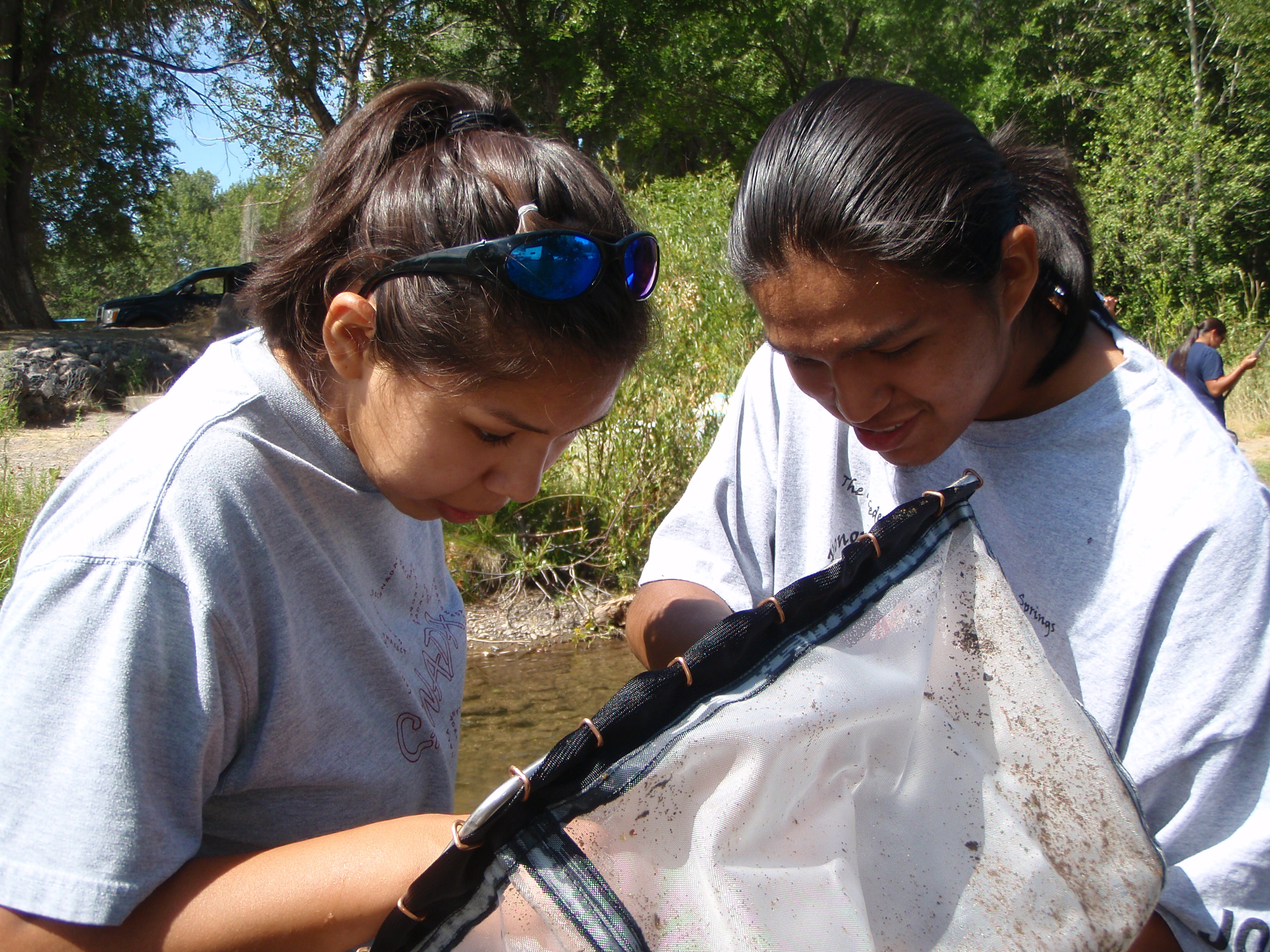
A New Generation of River Caretakers
These young people from the Warm Springs tribe examine invertebrates on Shitike Creek, a Deschutes River tributary, during a science field trip conducted by the Warm Spring Fisheries Department. Cheyenne Wahneta, on the left, is now a department employee. On the right is Allen LeClair.
