




Mark Selective Fisheries
Tuesday, July 16, 2013 in Comments Off on Mark Selective FisheriesIssue
In the case of Columbia River salmon (including steelhead), mark selective fisheries are any fisheries that allow the retention of fish with a clipped adipose fin (hatchery fish) and require the release of unclipped fish (generally wild fish). Mark selective fisheries result in differentially higher harvest impacts on clipped fish. Mark selective fisheries became a popular harvest management tool after the listing of salmon populations for protection under the Endangered Species Act and the mass fin clipping of hatchery fish. The costs of implementing and monitoring mark selective fisheries are considerable. For example, a mass-marking trailer costs around $1 million. Yet the benefits to wild populations remain unknown.
Proponents of mark selective fisheries claim that by maintaining low harvest impacts on wild stocks and removing additional hatchery fish that may stray and spawn in the wild, conservation benefits accrue to wild populations. While mark selective fisheries may reduce harvest impacts on wild populations, the benefits to wild stocks have not actually been quantified. In fact, no agency is evaluating the assumed benefits and fisheries managers have not agreed on an evaluation framework.
The tribes believe that implementation of mark selective fisheries has allowed non-treaty fisheries the opportunity to access a larger share of hatchery fish while maintaining the same allowable impacts on wild fish as would occur without mark selective fisheries.
For example, implementation of mark selective fisheries in 2008-2009 allowed non-treaty fisheries to harvest a greater allocation of Columbia River spring chinook than the treaty fisheries. Subsequently, the tribes and the states negotiated a modification to the U.S. v. Oregon Management Agreement, which provides for an equal sharing of the allocation.
The states now propose new chinook mark selective fisheries for the fall season Buoy 10 sport fishery and the fall season in-river sport and commercial fisheries. The states also propose mark selective in-river commercial coho fisheries. The tribes anticipate larger mark selective sport fisheries in the rest of Ocean Area 1-4 (north of Cape Falcon to Canada border) and in ocean commercial troll fisheries within the next few years. In addition, Canada is considering implementing mark selective fisheries in ocean fisheries known to impact Columbia River populations. These proposals raise a number of issues.
One issue concerns mortality rates on the released wild (non-marked or non-clipped) fish. Although release mortality rates vary greatly by fishery, significant losses are occurring in some fisheries. Yet no technical consensus exists on the release mortality rates that would be acceptable in any new mark selective fishery.
A second issue concerns current assessment models that do not adequately account for impacts of mark selective fisheries. There is no technical agreement on how to modify harvest models to appropriately account for impacts in mark selective fisheries.
A third issue concerns the poorly understood consequences of sequential mark selective fisheries on allocation and conservation objectives. Prior interceptions of mark selective fisheries change the mark rate of fish available to subsequent fisheries. This alteration in stock composition complicates management decisions made to achieve allocation and conservation goals.
Hypothesis and Needed Actions
Mark selective fishing is an allocation tool that allows access to more abundant hatchery (marked) fish. The abundance of naturally spawning populations will remain the same after implementation of mark selective fisheries and the allocation to non-Indian fisheries will continue increasing under mark select fisheries. We recommend the following actions.
- Determine actual release mortality in Columbia River fisheries instead of simply extrapolating from previous studies and studies in other areas. The proponents of mark selective fisheries should use their resources for new studies.
- Research potential impacts from multiple encounters. As mark selective fisheries expand, the probability of multiple recaptures of unmarked fish increases.
- Assess the impacts of mark selective fisheries on wild fish by adequately monitoring fisheries to determine the extent to which unmarked (wild) fish are being handled. Although direct observations provide the best information, they are not employed because of cost. Indirect observations, such as angler interviews, provide less accuracy in assessing impacts.
- Incorporate the effects of mark selective fishing in fishery planning models by using a range of estimates for release mortalities. The range of estimates needs to be adjusted annually based on observations from previous years. Fishery planning models should consider the gauntlet effect of subsequent mark selective fisheries because the mark rate will change and release mortality may increase as a result of the multiple encounters.
Expected Outcome
The research and monitoring of mark selective fisheries described above will determine the impacts on the restoration of wild stocks and harvest allocations. Once research and monitoring results are known, fisheries managers will adapt their conservation and allocation methods.
Marking Hatchery Fish
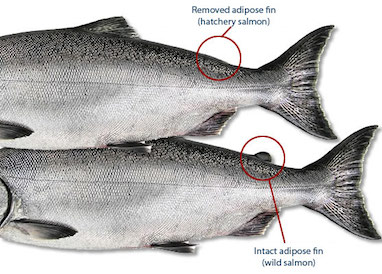
Marking Hatchery Fish
In mark selective fisheries, wild salmon must be released. No credible data exist, however, on the number of wild fish that die as a result of being caught and then released.
