




Land Use
Tuesday, May 21, 2013 in Comments Off on Land UseBegin improving in-channel stream conditions for anadromous fish by improving or eliminating land-use practices that degrade watershed quality.
Note: The land use problem statement, hypothesis, and recommended actions in the 1995 Spirit of the Salmon Plan remain relevant and applicable. Also see Biological Perspective, Habitat of Anadromous Fish in the Columbia River Basin.
Current Status
Some land-use practices have been altered to improve in-channel stream conditions in tributary watersheds in recent years. For example, forestry actions on federal lands have emphasized reduction of forest fragmentation; support of ecosystems as well as Endangered Species Act-listed species; culvert replacement with structures that promote natural stream bottoms; large-woody-debris movement; fish passage; recognition of connections of forest productivity with marine productivity; recognition of geomorphic processes producing high-quality fish habitat; and better treatment of roads to reduce landslides and sediment delivery. However, numerous land use practices that degrade watershed quality have not been sufficiently controlled. An important example is the continuing impact from agricultural practices that result in significant soil erosion and loss of riparian cover and livestock grazing damage to streambanks.
Assessment
Past land use recommendations made by CRITFC relied heavily on an extensive review of literature available to land management effects on streams and fish habitat (Rhodes, McCullough, and Espinosa 1994). Rhodes et al. developed the Coarse Screening Process in 1994. (See Table 5B.2 and Table 5B.3.) The Coarse Screening Process has been a significant reference in the Pacific Northwest used by land and fish managers (e.g., Muck 2010, Elliott et al. 2010, NMFS 1996, 1999) and in environmental appeals of federal actions having likely impacts to anadromous fish resources (e.g., ONRC/NEDC 2004).
Useful land management recommendations were similarly proposed by Henjum et al. 1994, USFS 1994, and Spence et al. 1995. The National Marine Fisheries Service (NMFS) and the U.S. Fish and Wildlife Service (USFWS) have proposed very useful guides for evaluating proper function of salmon and bull trout habitats and highlight the need to improve conditions before permitting habitat-disturbing actions (NMFS 1996, USFWS and NMFS 2000).
In all Northwest states, the standards established for protecting riparian habitat are routinely weak: Different standards are applied to fish- and non-fishing bearing streams, even though non-fish-bearing streams transport sediment, large woody debris, and thermal loads downstream to fish-bearing streams. Standards are inadequately monitored and enforced and do not reflect the latest scientific findings, among numerous other shortcomings.
Currently, Best Management Practices in agricultural management programs designed to meet the states’ water quality standards under the Clean Water Act non-point-source provisions are only weakly linked to instream performance criteria, are not sufficiently responsive to needed rates of habitat and water quality recovery, and are essentially voluntary (see McCullough 2010).
Improving land use activities will have the added benefit of making terrestrial/aquatic systems more resilient to perturbation caused by climate change (ISAB 2007) and helping to prevent introduction and spread of exotic plant and animal species into watersheds of the Columbia River Basin. (See the new technical recommendation Invasive Species.)
New and Modified Actions
- Maintain and improve integrity of riparian buffers and upland forests. Apply riparian buffers equal in width to those recommended by the Northwest Forest Plan (see Rhodes et al. 1994) and for both fish-bearing and non-fish-bearing streams to fully promote natural stream process restoration. Refrain from harmful salvage logging, especially in riparian buffers but also in upland forests to the degree possible (Beschta et al. 1995, 2004, USFS and BLM 1994). Protect structures against wildfire in the wildland-urban interface by clearing buffers surrounding the structures rather than thinning entire forests. Allow fire to assume a natural role in ecosystem modification to the extent feasible. Decrease fragmentation and increase connectivity among tracts of old growth and mature forest.
- Protect and restore natural processes (such as succession and disturbance) that allow aquatic ecosystems to restore and maintain themselves (see Mac et al. 1998a, 1998b, Ripple and Beschta 2004, ISAB 2011). (Also see Traditional Ecological Knowledge and Science .)
- Promote land use practices that will be sustainable under climate change impacts. Manage land use from a “gravel-to-gravel” or life cycle approach. Protect and restore habitats for all life stages of fish and the lateral and longitudinal migration corridors necessary for fish to move between them (see Fausch et al. 2002, Allen 2004, White et al. 2012).
- Continue to engage in selected reach- and watershed-level habitat monitoring programs that detect signals from climate change and land use and help understand how to restore and maintain sustainable and resilient ecosystems. The sites and monitoring methods should be coordinated at larger spatial and temporal scales as discussed in the institutional update Research, Monitoring and Evaluation.
- Monitor habitat conditions in representative watersheds using parameters described in McCullough and Espinosa (1996) and in the Columbia Habitat Monitoring Program (CHaMP) monitoring protocols. Habitat monitoring parameters are designed to follow trends in the habitat characteristics essential for abundance, productivity, genetic diversity, and spatial diversity of listed species (i.e., VSP parameters, McElhany et al. 2000). Improvement in habitat quality and quantity as revealed by a monitoring program such as CHaMP can imply the potential for species recovery by removal of limiting factors. Also needed are more comprehensive monitoring projects like the Integrated Status and Effectiveness Monitoring Program (ISEMP) that couples habitat and fish population monitoring.
- Use data on habitat quality trends in a full lifecycle model for each listed species to project population response to habitat trends and land restoration scenarios. A data-driven and formal model-based approach is urgently needed as a replacement to the qualitative, “expert-opinion” approach to habitat evaluation.
- Create a system of watershed reserves to act as anchor habitats to increase the stability of the habitat systems supporting aquatic resources.
Modified institutional actions:
- Implement and improve existing land use regulations. Implementing and enforcing land use regulations to provide full protection of fish habitat was an emphasis of the 1995 Spirit of the Salmon Plan; it remains a critical need that demands new strategies. These include land use practices cited in the Umatilla River Vision (Jones et al. 2008) and Oregon Department of Forestry and Oregon Department of Environmental Quality (2002); recommendations for protecting and restoring aquatic and terrestrial resources to sustainable levels in Rhodes et al. (1994), Spence et al. (1995), and Washington Coast Sustainable Salmon Partnership (2012); and actions known to improve and maintain water temperature regimes of streams cited in Rhodes et al. (1994), McCullough (1999), Independent Scientific Advisory Board (2007) and Beechie et al. (2012). (Also see the new technical recommendation Climate Change and learn about using General Land Office township survey data to document land use changes.)
- Improve existing regulations that are weak. Substantial improvement in Best Management Practices is needed in agricultural management programs designed to meet the states’ water quality standards under the Clean Water Act non-point-source provisions in TMDL (Total Maximum Daily Load is a calculation of the maximum amount of a pollutant that a waterbody can receive and still safely meet water quality standards).
Culverts Block Fish Passage
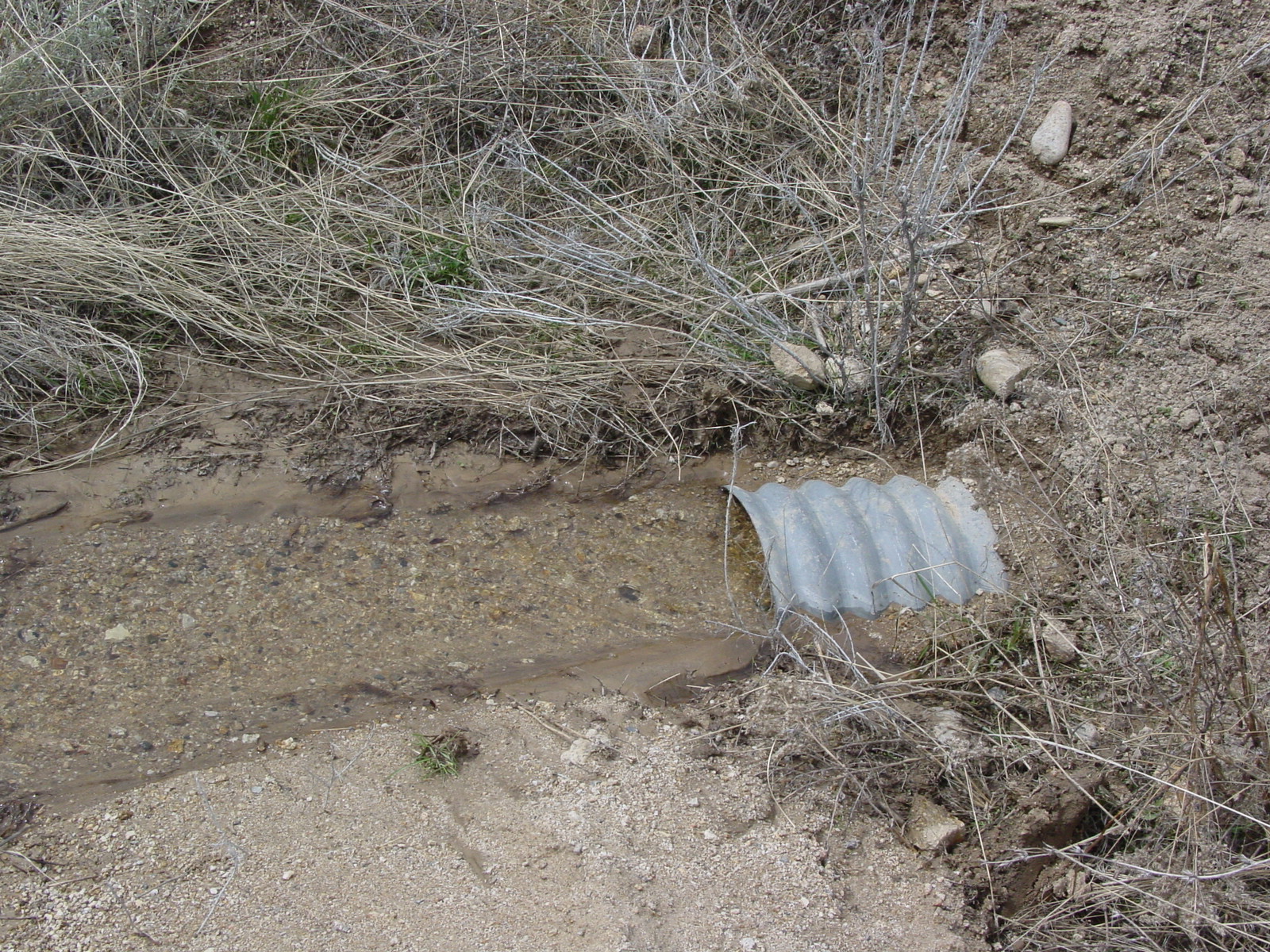
Culverts Block Fish Passage
Throughout the Columbia Basin, thousands of culverts route streamflow underneath roads, railroads and other obstructions. Above, the entrance to a submerged culvert is clogged, creating a barrier to fish.

The old design of culverts resulted in many of them lowering the stream level on their downstream side over time. This elevated culvert on Goat Creek Springs on the upper Methow River blocks fish passage. Landowners have agreed to replace the culvert and reconnect the springs to the river’s side channel so the area can support ESA-listed chinook, steelhead and other fish. While progress has been made replacing culverts, more work is needed.
Science & Tribal Knowledge
Plateau Tribes Facing Climate Change
Tribal populations dependent on natural resources are among the most climate-sensitive communities. Climate change impacts threaten tribal first food resources, culture and ways of life and tribal treaty rights. Considerable efforts have been made in the Columbia Basin to develop strategies to protect and restore populations of salmon, Pacific lamprey and other imperiled coldwater fish, but most of these efforts have generally not addressed climate change. Climate change is expected to significantly alter the ecology and economy of the Pacific Northwest during the 21st century. Rising air temperatures are expected to decrease snowfall and increase rainfall during the winter months, leading to shifts in the timing and quantity of runoff, including increased flooding during the winter when water is already in ample supply, and decreased flows during the summer when water demands are high.
Science & Tribal Knowledge
Plateau Tribes Facing Climate Change
Tribal populations dependent on natural resources are among the most climate-sensitive communities. Climate change impacts threaten tribal first food resources, culture and ways of life and tribal treaty rights. Considerable efforts have been made in the Columbia Basin to develop strategies to protect and restore populations of salmon, Pacific lamprey and other imperiled coldwater fish, but most of these efforts have generally not addressed climate change. Climate change is expected to significantly alter the ecology and economy of the Pacific Northwest during the 21st century. Rising air temperatures are expected to decrease snowfall and increase rainfall during the winter months, leading to shifts in the timing and quantity of runoff, including increased flooding during the winter when water is already in ample supply, and decreased flows during the summer when water demands are high.
