




Technical Recommendation 4
Supplementation
Use supplementation to help rebuild salmon populations at high risk of extinction.
Current Status
Hatchery production in the Columbia Basin comes primarily from conventional harvest augmentation programs, operated to mitigate for lost production associated with development of the hydrosystem. Most hatcheries upstream of Bonneville Dam continue to fulfill this role and support the tribal Zone 6 tribal fishery located between Bonneville and McNary dams. As outlined in the 1995 Spirit of the Salmon Plan, however, the tribes propose using additional supplementation to help rebuild natural populations. Abundance levels of natural populations throughout the interior basin are too depressed to provide significant tribal harvest and, in many cases, are so low that the long-term sustainability of the populations is threatened. Unlike conventional programs, supplementation hatcheries use adults captured in-river as broodstock, including a portion that are of natural origin, rear their progeny in a hatchery, and release them adjacent to natural spawning areas to which they are allowed to return as adults and augment the spawning population.
The tribes now manage or co-manage, with federal and state partners, several supplementation hatchery programs in the interior basin. Appendix C, 2008-2017 U.S. v. Oregon Management Agreement Production Tables, provides a list of all hatchery programs in operation above Bonneville Dam. The May 31, 2012 revision of the tables indicates the current co-managers agreed to juvenile production targets and release sites and identified the primary program purpose for each as conservation, supplementation, fishery, reintroduction and/or research.
Assessment
Results from the supplementation programs suggest that with judicial management, they can provide the sought after demographic benefits while sufficiently controlling for effects on other viable salmonid parameters (McElhany et al. 2000) that might be associated with artificial spawning and rearing (Hedrick et al. 2000, Sharma et al. 2006, Berejikian et al. 2009, Eldridge and Killibrew 2008, Knudsen et al. 2008, Schroder et al. 2008, Schroder et al. 2010, Hess et al. 2012). Declines in natural population abundance have been reversed in response to some of these supplementation programs, though reduced habitat productivity and hydrosystem mortality continue to constrain natural growth.
Importantly, returns have been sufficient in several of these streams and rivers to reestablish terminal tribal fisheries at usual and accustomed locations. In other populations, the habitat and hydrosystem effects continue to depress population productivity, though supplementation has at least served to maintain abundance. The programs are monitored at varying levels of intensity to provide information to assess trends in abundance, productivity, spatial structure and diversity and help guide (adaptive) management.
The tribes proposed that the supplementation programs be managed based on guidelines described in detail by Cuenco et al. (1993) including:
- Supplementation hatchery programs must necessarily be enacted in concert with efforts to restore habitat, improve hydrosystem survival and manage harvest.
- Program scale should be appropriate to both mitigation needs and match the potential natural productivity of the stream.
- Use of natural-origin broodstock as feasible to increase integration with the natural population and promote local adaptation.
- Adopt spawning and rearing practices to maintain genetic diversity and to produce behavioral and physical phenotypes of hatchery origin fish that are (more) similar to those of natural-origin fish.
- Acclimate and release hatchery-origin juveniles in locations within spawning areas to promote adult homing for natural reproduction.
While gains have been achieved and the threat of extirpation has been substantially reduced, essentially none of the natural populations in the interior Columbia Basin can be deemed naturally abundant and self-sustaining. Reduced habitat productivity and hydrosystem mortality continue to constrain natural growth of these populations. As a result, these populations remain in need of further support from hatchery supplementation. Additionally, the supplementation recommendations made in 1995 have been only partially implemented, and often program management does not yet adequately conform to the Cuenco et al. (1993) guidelines. For many programs:
- Funding for program infrastructure is insufficient.
- Current hatchery facilities cannot rear fish at desired low densities and under semi-natural conditions.
- Acclimation facilities are too few and often located lower in the basin (downstream of much of the natural spawning area) than is preferable.
- Program scale is sometimes reduced relative to tribal proposals.
- Limitations are sometimes imposed on the number of natural-origin fish that can be used for broodstock and the number of hatchery-origin adults permitted to escape for natural spawning.
New and Modified Actions
The tribes will continue to seek additional funding for infrastructure, operation and monitoring activities for each of the various programs as needed and continue to promote adherence to supplementation management guidelines. The tribes will also continue efforts to obtain funding for construction and operation of the following proposed hatcheries:
- Northeast Oregon Hatchery
- Wahkiakus Hatchery (Klickitat River)
- South Fork Walla Walla River Hatchery
- Yakima River fall chinook hatchery
Restoration Successes
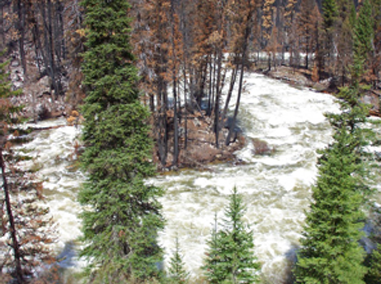
Johnson Creek Summer Chinook
Researchers found hatchery-reared salmon that spawned with wild salmon had the same reproductive success as salmon left to spawn in the wild, according to a study of the Nez Perce Tribe’s Johnson Creek Artificial Propagation Enhancement Project. The study focused on a population of summer chinook whose natal stream is located in central Idaho, almost 700 miles upstream of the Pacific Ocean. …
Restoration Successes
Johnson Creek during the spring runoff.
Johnson Creek Summer Chinook
Researchers found hatchery-reared salmon that spawned with wild salmon had the same reproductive success as salmon left to spawn in the wild, according to a study of the Nez Perce Tribe’s Johnson Creek Artificial Propagation Enhancement Project. The study focused on a population of summer chinook whose natal stream is located in central Idaho, almost 700 miles upstream of the Pacific Ocean. …
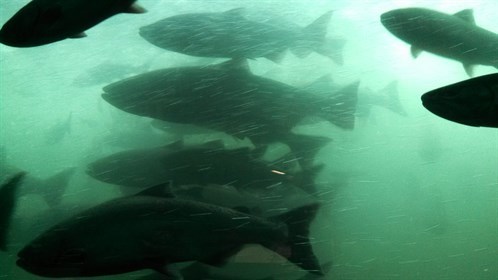
Snake River Fall Chinook Supplementation
In 2013 the Nez Perce Tribe’s Snake River recovery program resulted in the highest number of wild fall chinook to return to the Snake River since 1960. When these chinook spawned, the results were a record-setting 63,000 redds, the rocky nests were fish lay and fertilize their eggs, in the Snake and Clearwater river basins. The increase in Snake River returns and the increased distribution in redds were aided by the tribal program that supplements existing Snake River fall chinook populations.
Read more about the 2013 returns and the tribe’s challenges to get there »
A record number of Snake River fall chinook spawned in the Snake River basin in 2013. Pictured above, fall chinook and other salmon at a dam's fishing counting window. Photo courtesy of the Northwest Power and Conservation Council.
Snake River Fall Chinook Supplementation
In 2013 the Nez Perce Tribe’s Snake River recovery program resulted in the highest number of wild fall chinook to return to the Snake River since 1960. When these chinook spawned, the results were a record-setting 63,000 redds, the rocky nests were fish lay and fertilize their eggs, in the Snake and Clearwater river basins. The increase in Snake River returns and the increased distribution in redds were aided by the tribal program that supplements existing Snake River fall chinook populations.
Read more about the 2013 returns and the tribe’s challenges to get there »
